
If you’re planning to sit for the PMP certification exam anytime soon, here’s a question that should be keeping you up at night: are you studying from an outdated blueprint? The Project Management Institute (PMI) has just released its updated Examination Content Outline (ECO) for July 2026, and it reshapes exactly what gets tested, how it’s tested, and how heavily each topic counts toward your final score. Walking into your exam without understanding these changes is like showing up to a race without knowing the course. Stick with me through this breakdown, and you’ll know precisely what to expect and how to prepare with confidence.
What Is the PMP Exam Content Outline (ECO) and Why Does It Matter?
For beginners, the ECO is essentially PMI’s official “blueprint” for the exam. It’s built from a Job Task Analysis (JTA), a research process where PMI studies what practicing project managers actually do day-to-day, then maps those real-world responsibilities into the domains, tasks, and enablers that appear on your exam. Think of a “task” as a core responsibility (like managing conflict), and an “enabler” as a concrete example of that responsibility in action (like identifying the source of a disagreement between stakeholders).
The July 2026 update reflects PMI’s effort to account for emerging trends reshaping the profession, particularly artificial intelligence and sustainability, which are now woven directly into the exam’s scenario-based questions rather than treated as standalone topics. If you’ve been following the broader shift toward the PMBOK 8th Edition, this ECO update is part of that same evolution in how PMI defines competent, modern project leadership.
Breaking Down the Three Domains: Where Your Study Time Should Go
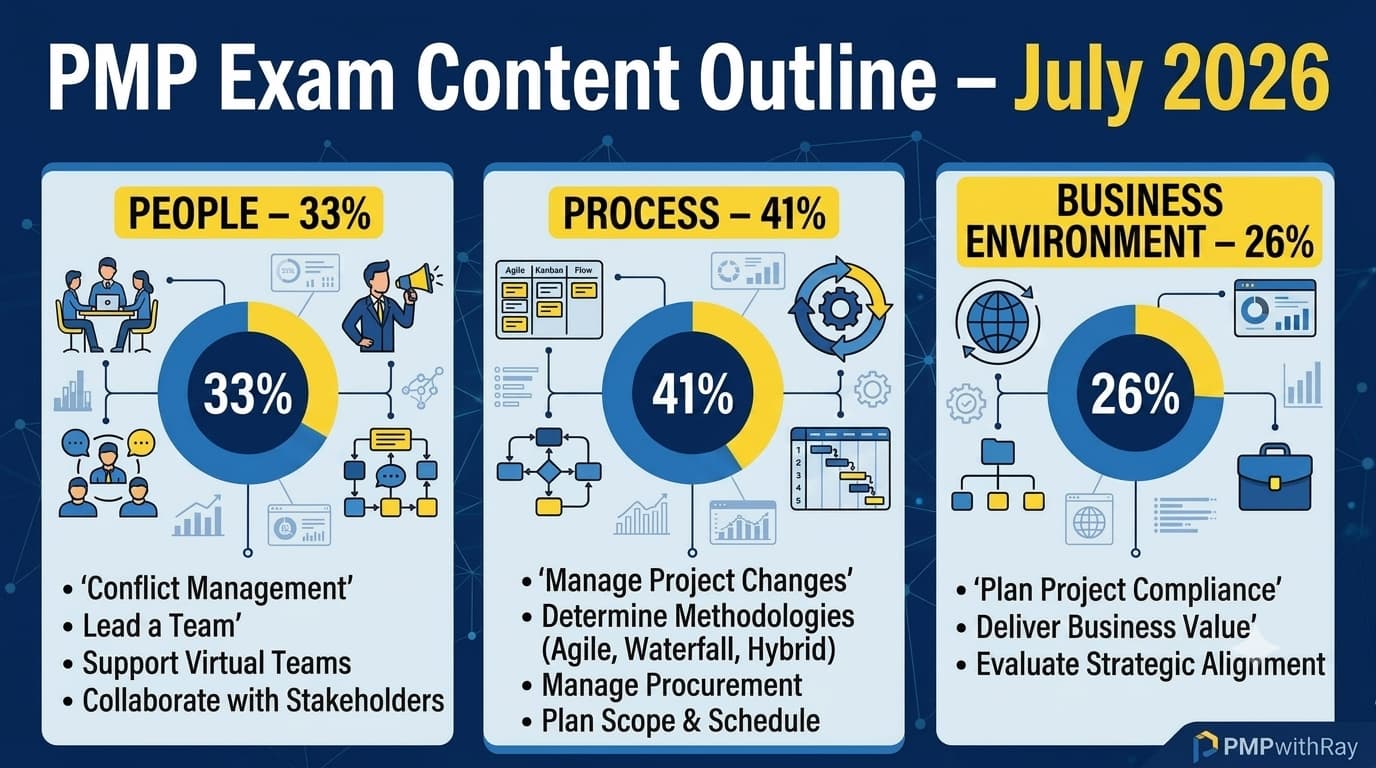
The exam remains organized into three domains, and knowing their weight helps you prioritize your prep:
- People (33%) — covers leading teams, managing conflict, engaging stakeholders, and ensuring knowledge transfer.
- Process (41%) — the heaviest domain, covering integrated planning, scope, scheduling, procurement, finance, quality, and project closure.
- Business Environment (26%) — governance, compliance, risk, organizational change, and external environment shifts like regulation and geopolitics.
A critical detail beginners often miss: these domains aren’t tied to a single methodology. Roughly 40% of exam items reflect predictive (traditional/waterfall) approaches, while the remaining 60% split between adaptive/agile and hybrid approaches. That means you genuinely need fluency across methodologies. If you’re still deciding which approach to study first, my guide comparing Agile vs Waterfall is a solid starting point.
New Question Formats You Haven’t Seen Before
This update introduces question types that go beyond simple multiple choice, and they demand a different kind of exam readiness:
- Case or Scenario questions present a detailed business situation, sometimes with charts, and ask you to answer a series of connected questions based on that single scenario.
- Graphic-Based questions require you to interpret visual data, like a Requirements Traceability Matrix or a cost chart, before selecting your answer.
Alongside these, you’ll still encounter matching, drag-and-drop, point-and-click, and pull-down list formats. The exam itself totals 180 questions (170 scored, 10 unscored pretest items) across 240 minutes, with two built-in breaks. The takeaway for newcomers: rote memorization won’t carry you through this exam. You need to practice interpreting data and applying judgment to realistic project situations, which is exactly why staying current on the 2026 exam changes matters so much right now.
Eligibility and Retakes: What Aspiring PMs Should Confirm Before Applying
Eligibility pathways remain tiered by education level, ranging from a secondary school diploma with 5 years of non-overlapping project leadership experience, up to a bachelor’s degree with just 2 years of experience. All candidates also need at least 35 hours of project management training, though active CAPM certification holders get this waived automatically. If you’re unsure which pathway applies to you, I’ve broken down the full PMP eligibility requirements in detail. On retakes, you get up to three attempts within your one-year eligibility window before a mandatory one-year waiting period kicks in, so preparation quality matters more than ever.
Ready to Prepare with Confidence?
Understanding the ECO is step one, applying it strategically is what actually gets you certified. If you want these concepts broken down visually with real exam-style walkthroughs, subscribe to my YouTube channel, PMPwithRay, where I cover every domain change in detail. And if you’re serious about structured, exam-aligned prep built specifically around this updated content outline, check out my PMP certification courses on Udemy to start building real exam readiness today.