
If you’re gearing up for the PMP exam, one detail can quietly wreck an otherwise solid preparation plan: exam duration. Walk in expecting the old timing and pacing, and you could either rush through questions you actually knew, or burn your break time in the wrong place. With PMI’s official Examination Content Outline update aligned to PMBOK 8th Edition, the exam’s timing structure has changed. Let’s break down exactly how long the PMP exam is now, how the breaks work, and what question patterns you’ll be racing against the clock to solve.
The New PMP Exam Duration: 240 Minutes
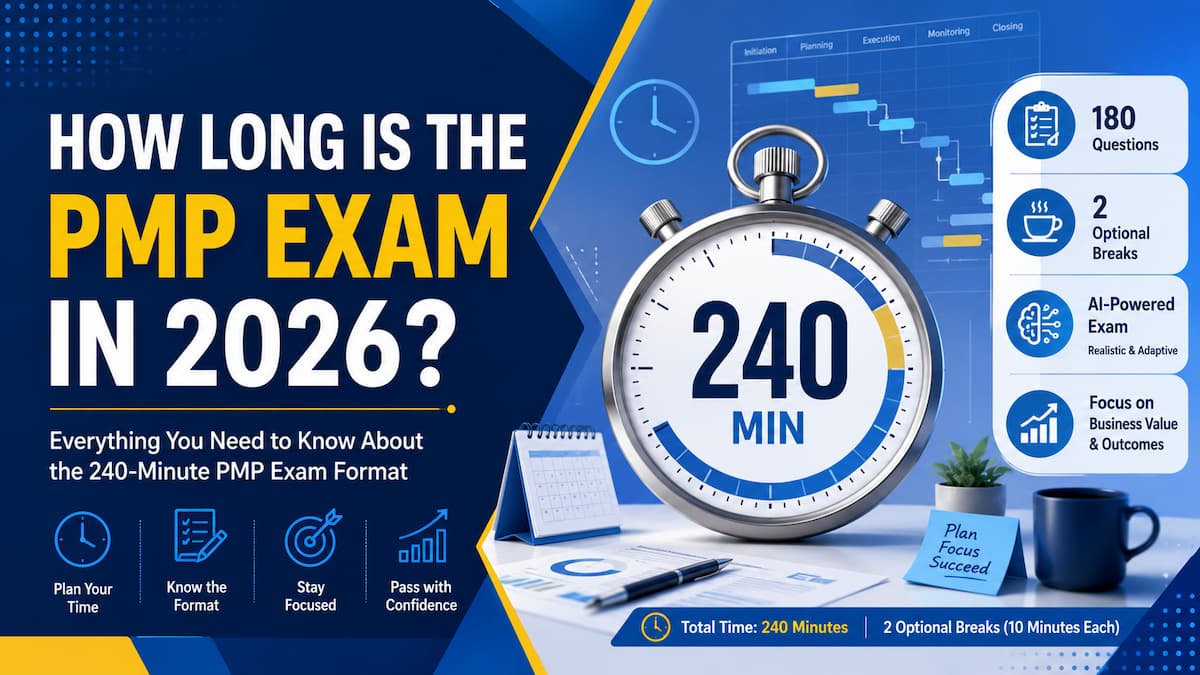
According to PMI’s official 2026 Examination Content Outline, the allotted exam time to complete the center-based exam is 240 minutes, and it may take you less than the allotted time to complete the exam. That’s four full hours of testing time, an increase from the previous 230-minute format. If you’re wondering why this matters, it comes down to pacing: with 240 minutes for 180 total questions, you get roughly 80 seconds per question on average, a modest but meaningful cushion compared to the tighter margin candidates faced under the earlier format.
For beginners, it’s worth clarifying that “allotted time” refers strictly to active question-answering time. The tutorial at the start and the survey at the end are both optional, and PMI confirms that the time used to complete the tutorial and survey is not included in the exam time of 240 minutes (4 hours). So your four-hour clock is protected purely for questions, not administrative steps.
Breaking Down the 180 Questions: Scored vs. Pretest
The total question count on the exam remains at 180, but the internal split has shifted. Per the official ECO, of the 180 questions, 10 are considered pretest questions, meaning the exam contains 170 scored questions and 10 unscored pretest items, up from the 5 pretest questions on the prior version. Pretest questions don’t affect the score and are used in exams as an effective and legitimate way to test the validity of future exam questions, and all questions are randomly placed throughout the exam, so you won’t know which ones are scored while you’re testing. This is exactly why treating every single question with equal seriousness matters; you genuinely cannot tell which ones count.
If you’re building your study calendar around this timeline shift, it pairs directly with the broader content changes I’ve outlined in my breakdown of the PMP exam 2026 changes, including the new domain weightings tied to PMBOK 8th Edition.
Your Two Scheduled Breaks: When and How They Work
Time management on exam day isn’t just about answering speed; it’s about knowing when your breaks fall and using them strategically. PMI’s official outline confirms there are two 10-minute breaks in the exam. The first break occurs after the case-study section, and the second break occurs approximately midway through the independent question portion of the exam.
Here’s the critical rule beginners often overlook: once you start your break, there’s no going back. The PDF is explicit that once you review your responses and start your break, you will not be able to return to the questions from the previous section of the exam. That means before you click into break mode, you need full confidence you’ve answered everything in that section the way you intend to, because that door closes permanently. If you’re testing online via Online Proctored Tests (OPT), be ready for extra friction, too. Candidates taking an OPT exam may be asked to present their identification to the proctor after they return from a break, before continuing with the exam.
New Question Patterns Behind the Longer Clock
The extended time isn’t arbitrary; it reflects genuinely more demanding question formats introduced with this update. Two are entirely new: Case or Scenario questions, where the candidate is presented with a detailed scenario or situation, which may include graphs or charts to provide additional context, followed by a series of questions based on all the information provided, and Graphic-Based Questions, which require the candidate to refer to, and interpret visual information, such as charts, graphs, diagrams, or images before answering.
Alongside these, you’ll still face familiar formats like multiple-choice single response, multiple-response questions, matching, point-and-click, and pull-down list items. But now you’re managing scenario chains and visual interpretation within your pacing, not just standalone questions, which is precisely why PMI extended the clock. If you’re unsure how to structure study time around these newer formats, my guide on PMP exam prep walks through a practical approach.
Retake Timing: What Happens If You Don’t Pass
Duration planning doesn’t stop at exam day. If you don’t pass, PMI’s policy states you may take the exam up to three times within your 1-year eligibility period, after which you must wait 1 year from the date of the last exam before you reapply for the certification. However, during this year, you are welcome to apply for any other PMI certification, so the setback doesn’t have to be a dead end for your credentialing journey. For a deeper look at bouncing back strategically, see my article on PMP exam retakes.
Train for Four Hours, Not Three and a Half
The single biggest mindset shift for 2026 candidates: this exam demands sustained focus across a genuine four-hour block, with heavier scenario and graphic-based reasoning built into that time. Practicing under real, timed, four-hour conditions before exam day isn’t optional anymore; it’s essential. For structured video walkthroughs of exactly how to pace yourself against these new question types, subscribe to PMPwithRay on YouTube, and if you want full-length timed simulations built around the updated 2026 exam format, check out my PMP Certification Exam Mock Simulator on Udemy to build the stamina and pacing instincts you’ll need on test day.