
Picture two project managers delivering identical projects: same budget, same timeline, same scope. One finishes and walks away. The other finishes having also reduced waste, protected community wellbeing, and left the organization more resilient for the next decade. According to PMI’s own research, that second project is now statistically more likely to be called a success. If you’re preparing for a PM career or the PMP exam, ignoring this shift means walking in unprepared for how the profession is actually being judged today. Let’s unpack exactly what PMBOK 8th Edition says about sustainability and why it should reshape how you think about every project you touch.
Sustainability Is Now a Standalone Principle, Not a Side Note
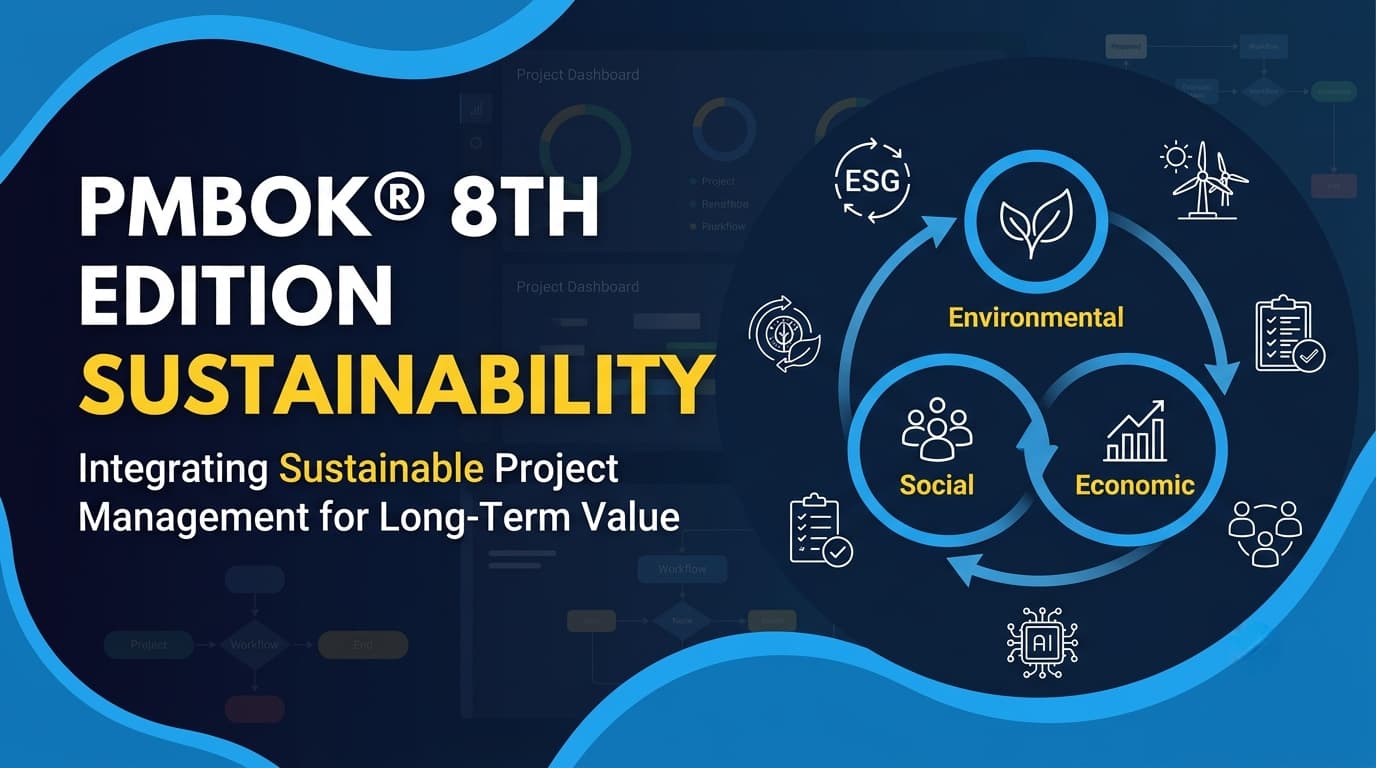
Here’s the terminology check for beginners: a “principle” in PMBOK language is a fundamental guideline that shapes how a project manager behaves and makes decisions, regardless of industry or methodology. In the 7th Edition, sustainability-adjacent ideas were scattered across broader principles. The 8th Edition consolidates twelve principles down to six, and one of them stands entirely on its own: Integrate Sustainability Within All Project Areas, addressing environmental, social, and economic sustainability. That elevation matters. It signals PMI treats sustainability as core professional competence, not an optional add-on for “green” industries. Projectmanagementpmo
This principle asks project managers to balance business success with Environmental, Social, and Governance (ESG) considerations wherever appropriate, evaluate the long-term impact of project decisions, promote responsible resource management, and adopt sustainable business practices while continuing to deliver value. If ESG is a new term to you, think of it as a simple lens: does this project decision help or harm the environment, the people affected by it, and the organization’s governance standards, alongside the usual scope, time, and cost concerns? For a deeper look at how the full principle-to-domain structure changed, I’ve covered that in my PMBOK 8th Edition preview. Learning Tree
A Dedicated Focus on Sustainable Project Delivery
Beyond the principle itself, PMBOK 8 goes further than any previous edition by giving sustainability structural, practical space in the guide. Sources tracking the new edition confirm it integrates sustainability throughout the project lifecycle and frames project managers as central to the mission, noting that projects play a pivotal role in realizing sustainable practices and outcomes by considering people, planet, society, and value. That “people, planet, value” framing echoes a concept many of you may have already encountered: the triple bottom line, which asks organizations to weigh social equity and environmental impact alongside financial profitability, rather than profitability alone. Projectmanagementpmo
This isn’t confined to a single chapter either. Alongside sustainability, the guide expands practical guidance around AI, procurement, and PMO functions, with reporting noting in-depth discussions and appendices on the use of artificial intelligence in the management of projects, sustainable project delivery, ethical technology use and customer-focused PMO functions. In other words, sustainability shows up as woven guidance across the guide’s structure rather than a single isolated topic to memorize and forget. Pmpwithray
Why This Matters for Your Career, Not Just Your Exam Score
This is the part that should really grab your attention as an aspiring PM. PMI’s most recent global research found sustainability isn’t just a compliance checkbox, it’s a performance predictor. In a survey of nearly 1,600 professionals across 35 countries, PMI and Green Project Management (GPM) found that 79% of respondents say sustainability positions their organizations for long-term success, yet only 41% report that it is fully integrated across projects and functions. Even more revealing is the confidence gap between leadership and delivery: 85% of sustainability executives are confident their organization can achieve its goals, while only 43% of PMO leaders agree, and just 20% of project professionals are extremely confident. PMI
Translate that into plain career terms: organizations want sustainability results, but very few project professionals currently feel equipped to deliver them. That gap is your opportunity. PMI has even formalized this urgency by partnering with GPM specifically to fill a global green talent gap projected to grow 101.5% by 2050, as demand for sustainability-aligned projects surges. Employers are actively searching for project managers who can hold both the technical delivery skills and the sustainability mindset. If you’re also weighing which credentials complement this direction, my guide on PMP certification value is a useful companion read. Yahoo Finance
How to Start Building Sustainability Competence Now
You don’t need to wait for the July 2026 exam update to start thinking this way. Begin practicing three habits on every project you work on, even hypothetical ones in your studies: first, ask what the environmental footprint of your project decisions actually is, not just what stakeholders explicitly request. Second, evaluate social impact, meaning who benefits and who might be disadvantaged by your project’s outcomes. Third, document sustainability considerations the same way you’d document risk or scope, so it becomes a visible, defensible part of your project management plan rather than an afterthought.
Get Ahead of This Shift Before Your Peers Do
Sustainability has moved from a “nice to have” into one of PMI’s six core principles and a genuine differentiator in the job market. The project managers who understand this now, before it’s fully mainstream in every job description, will be the ones organizations trust with their most strategic initiatives. Want to go deeper into how PMBOK 8th Edition and the July 2026 exam changes connect? Subscribe to PMPwithRay on YouTube for full breakdowns, and if you’re ready to build certification-ready skills around this new standard, check out my project management courses on Udemy to get exam-ready with confidence.