
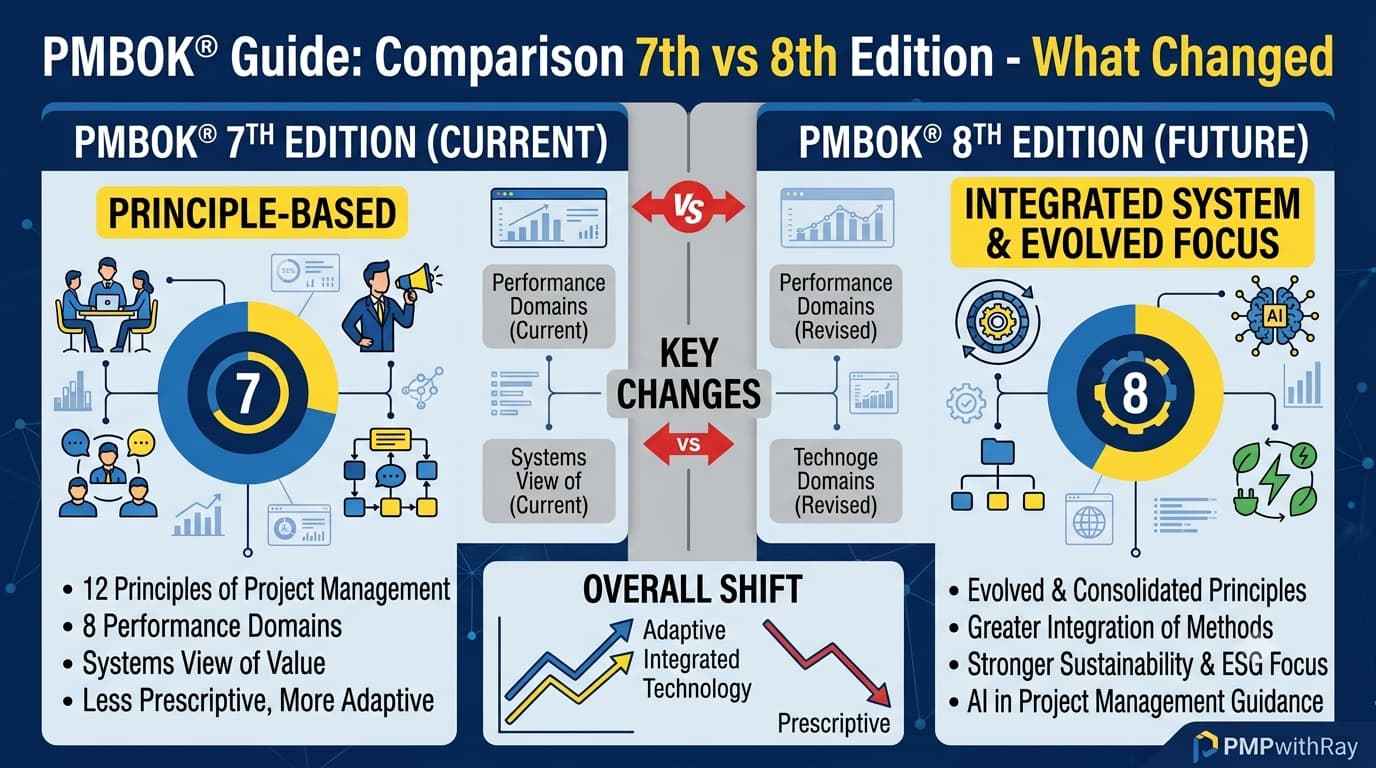
Imagine studying hard for months using PMBOK 7th Edition material, only to discover on exam day that the entire principle structure, domain names, and even the definition of “project” itself have changed underneath you. That’s the exact risk facing candidates right now. The PMBOK 8th Edition isn’t a light refresh, it’s the most structurally significant revision since the 6th Edition, built from roughly 48,000 data points gathered from practitioners worldwide. Here’s exactly what shifted in the PMBOK 8th Edition, and why every aspiring project manager needs to understand it before choosing their study path.
From 12 Principles to 6: How the PMBOK 8th Edition Sharpens the Framework
PMBOK 7 introduced 12 guiding principles, but PMI’s research found many overlapped confusingly with performance domains. The PMBOK 8th Edition consolidates these into 6 streamlined principles by merging related ideas together. For example, “Recognize, Evaluate, and Respond to System Interactions” and “Navigate Complexity” merged into a single Holistic View principle, while four separate PMBOK 7 principles collapsed into one unified Focus on Value principle. Most notably, a completely new principle appeared with no prior equivalent: Integrate Sustainability Within All Project Areas. This isn’t cosmetic tidying, it reflects PMI’s data showing practitioners wanted fewer, more actionable guidelines rather than an abstract list. If you want the full picture on how sustainability earned its own dedicated principle in the PMBOK 8th Edition, I’ve covered that separately in my piece on PMBOK 8th Edition sustainability.
8 Domains Become 7: Governance Gets Its Own Spotlight in the PMBOK 8th Edition
For beginners, a “performance domain” represents a major area of activity a project manager must actively manage, like stakeholders, risk, or scope. PMBOK 7 organized these into 8 domains. The PMBOK 8th Edition restructures this into 7 domains by synthesizing the old domains with previously separate Knowledge Areas like Scope, Schedule, Finance, and Resources, folding the standalone Uncertainty domain into Risk. The single biggest addition is Governance, an entirely new domain that didn’t exist as a formal performance domain in PMBOK 7, which had covered organizational governance in barely a page. Now it spans 9 distinct processes covering everything from project initiation through closure, formally connecting organizational strategy to how projects actually get executed day to day.
Process Groups Return in the PMBOK 8th Edition, Renamed as “Focus Areas”
Here’s a genuinely interesting reversal: PMBOK 7 removed Process Groups entirely in favor of pure principles-based guidance. But PMI’s own research found 80% of practitioners actually wanted them reintroduced, alongside 79% wanting concrete processes embedded back into the guide. The PMBOK 8th Edition responds by bringing back the same five familiar concepts, Initiating, Planning, Executing, Monitoring & Controlling, and Closing, but rebrands them as “Focus Areas” and repositions them in a genuinely important way: they’re now explicitly approach-agnostic, meaning they apply equally whether you’re running a predictive, agile, or hybrid project, rather than being tied to traditional waterfall thinking. Alongside this, 40 nonprescriptive processes return too, though candidates don’t need to memorize every one, the key idea is that teams tailor which processes actually apply to their specific project.
Redefining “Project” Itself and Adding a Fourth Tailoring Step
Even foundational terminology shifted in the PMBOK 8th Edition. PMBOK 7 defined a project as creating “a unique product, service, or result.” The PMBOK 8th Edition redefines it as creating “value” within “a unique context,” a subtle but exam-relevant change signaling that success is now measured by delivered value, not just completed outputs. Tailoring also gained a new fourth step, Implement Ongoing Improvement, making tailoring an iterative, recurring activity through retrospectives and phase gates rather than a one-time exercise at project kickoff. For candidates weighing whether to sit the current exam or wait, my breakdown of the PMP exam 2026 changes walks through the full transition timeline.
AI Gets Its Own Appendix for the First Time in the PMBOK 8th Edition
PMBOK 7 didn’t mention artificial intelligence at all. The PMBOK 8th Edition introduces an entirely new Appendix X3 dedicated to AI, covering three practical adoption strategies for project managers: Automation for low-complexity repeatable tasks, Assistance for moderate-complexity work like drafting risk registers, and Augmentation for high-complexity strategic analysis. This reflects how deeply AI has embedded itself into modern project delivery, a trend I explore further in my article on whether the PMBOK 8th Edition replaces PMBOK 7th Edition.
Prepare for the Standard That’s Actually Being Tested
Studying outdated material against a completely restructured exam is a costly mistake you can easily avoid. Get the full video walkthrough of every PMBOK 8th Edition principle, domain, and process change on PMPwithRay’s YouTube channel, and when you’re ready to build real exam readiness aligned to the PMBOK 8th Edition, explore my PMP Certification Exam training on Udemy to study with confidence.