
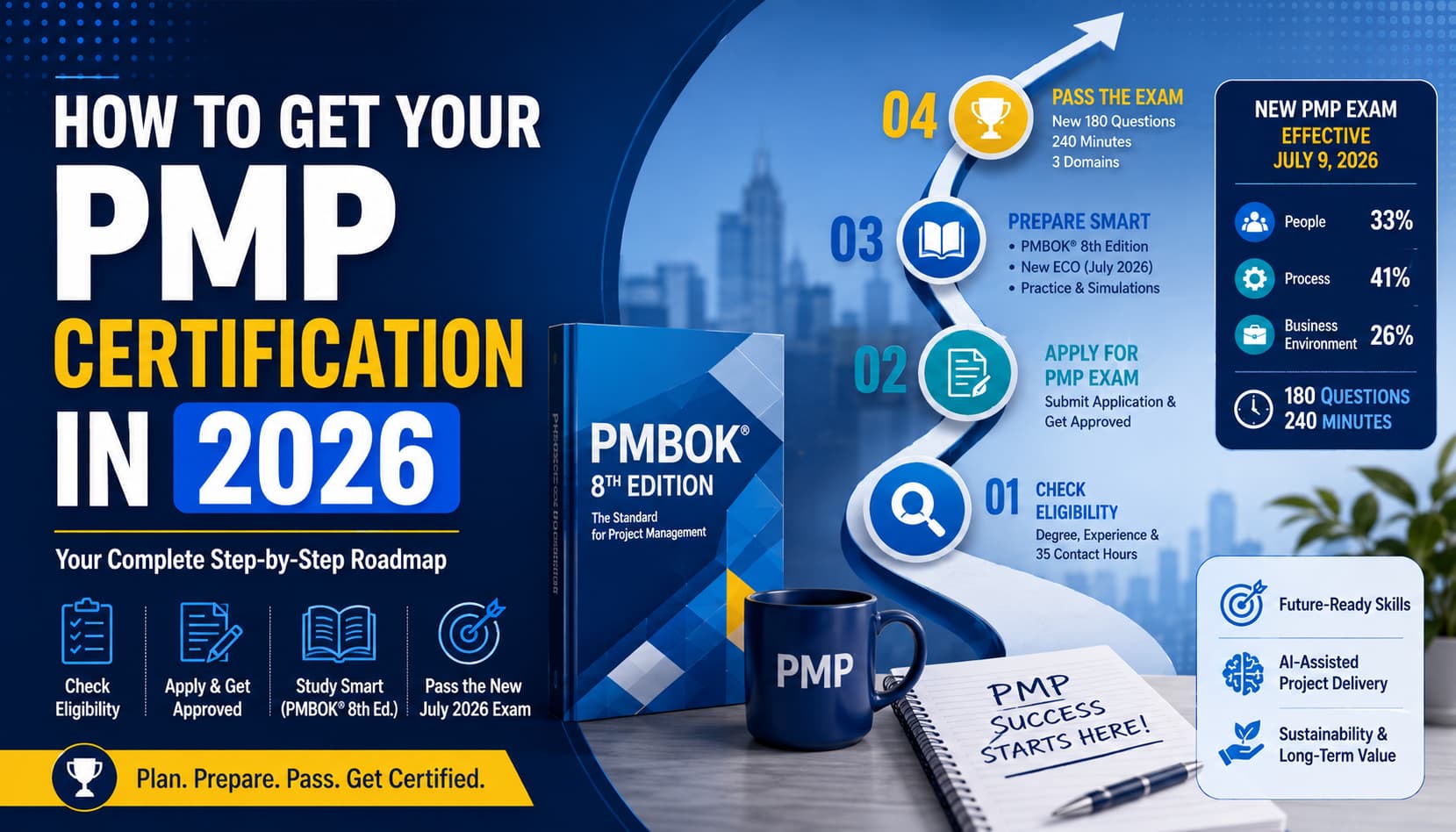
So you want your PMP certification in 2026 — but between the new July 2026 exam format, PMBOK 8th Edition, and a maze of conflicting advice online, it’s genuinely hard to know where to start. Get even one step wrong — like applying before your experience hours qualify, or studying outdated material — and you could lose weeks or fail your first attempt. This guide walks you through exactly how to get your PMP certification in 2026, from checking eligibility to passing the redesigned exam, so you can move forward with confidence instead of guesswork.
What Are the PMP Certification Eligibility Requirements in 2026?
To qualify for the PMP exam in 2026, you need either a four-year degree with 36 months of project-leading experience, or a high school diploma/associate degree with 60 months of experience, plus 35 contact hours of formal project management education. PMI added a middle tier this year too: candidates with an associate degree or equivalent technical qualification now only need 48 months of experience instead of 60.
“Project management experience” here means time spent leading and directing projects, not just supporting one — PMI checks this closely, and your experience must fall within the last 10 years. The 35 contact hours can come from an instructor-led course, a PMI Authorized Training Partner, a university class, or an equivalent — informal study like reading books or watching free webinars doesn’t count. If you’re unsure exactly where you stand, I’ve broken down every eligibility pathway in detail in my PMP Certification Eligibility Requirements guide.
How Do You Actually Apply for the PMP Exam?
Once you meet the eligibility criteria, you apply for the PMP exam through PMI’s own online portal by creating a PMI account and submitting your education and experience history. PMI reviews every application, and this review — including a possible random audit requiring documentation — typically takes anywhere from 5 to 30 business days.
Be precise when logging your project experience: list accurate start and end dates for each project, and keep your certificates and transcripts ready in case PMI selects your application for audit. Sloppy or vague entries are the most common reason applications get delayed or rejected outright. Once approved, you’ll pay the exam fee — $405 for PMI members and $655 for non-members — and can schedule your exam through Pearson VUE, either online proctored or at a physical testing center.
What Does the New July 2026 PMP Exam Actually Test?
The PMP exam changed format on July 9, 2026, and now tests 180 questions across three domains in 240 minutes: People (33%), Process (41%), and Business Environment (26%). This update aligns the exam with PMBOK 8th Edition, which replaced the old process-group structure with performance domains and added new content on AI-assisted project delivery and sustainability.
Because the content outline shifted, studying from pre-2026 materials is a real risk — you could spend weeks mastering concepts the exam no longer emphasizes. Prioritize resources explicitly updated for PMBOK 8th Edition and the current Examination Content Outline (ECO), and build in time for full-length practice simulations well before your scheduled date. For a full breakdown of what’s different in the new format, see my dedicated guide on the PMP Exam 2026 Changes.
What Should You Budget For Beyond the Exam Fee?
Getting your PMP certification costs more than just the exam fee, so plan your total budget before you start rather than discovering hidden costs mid-preparation. Beyond the $405–$655 exam fee, factor in your 35-contact-hour training course, PMI membership (roughly $164/year, which usually pays for itself through the exam-fee discount), and a buffer for a possible retake, which currently runs $275–$375.
Most candidates spend between 2 and 4 months preparing, depending on how much project management exposure they already have and how many hours per week they can commit to study. Rushing this timeline to “save time” is one of the most common reasons candidates walk into the exam under-prepared and end up paying for a retake anyway. I’ve laid out every cost component candidates typically miss in my complete PMP exam cost guide.
FAQs: Getting Your PMP Certification in 2026
No. PMI offers multiple eligibility pathways — a high school diploma with 60 months of experience, or an associate degree/equivalent with 48 months, both work alongside a four-year degree with 36 months.
Most candidates take 3–6 months total: roughly 2–4 weeks for application review, then 2–4 months of study before sitting the exam, though this varies based on your existing PM background.
Yes. Since the exam was updated on July 9, 2026, all current exam content is aligned to PMBOK 8th Edition’s performance domains and principles rather than the older process-group structure.
Yes. PMI offers both online proctored exams through Pearson VUE and in-person testing at physical Pearson VUE centers — you choose whichever format suits you when scheduling.
Your Next Step Toward PMP Certification
Getting your PMP certification in 2026 comes down to three things: confirming your eligibility accurately, applying carefully, and preparing with materials genuinely built for the new exam format. With over 15 years of hands-on project management experience, I’ve built my training resources specifically around PMBOK 8th Edition and the current ECO, so you’re never studying outdated content. Subscribe to my PMPwithRay YouTube channel for free weekly exam-prep breakdowns, or fast-track your studying with my PMP certification courses on Udemy — including a full 35 PDU training program built for the 2026 exam.