
You’ve committed to earning your PMP certification and immediately face a overwhelming question: what exactly should you study? Walk into any bookstore or search online, and you’ll find hundreds of resources claiming to be “essential” for PMP success—thick prep books, video courses, practice exam simulators, flashcard sets, and countless study guides. Some candidates spend thousands of dollars collecting materials, only to feel more confused about where to focus their limited study time. Others choose the wrong resources entirely and waste months studying outdated or irrelevant content.
Here’s what successful PMP candidates understand: the Project Management Institute provides an official reference list—a carefully curated collection of materials that exam question writers actually use when developing exam content. These aren’t random recommendations; they’re the authoritative sources that define what “correct” means on exam day. According to PMI data, candidates who align their preparation with official references significantly outperform those relying solely on third-party materials. With major exam changes coming in July 2026 and the release of PMBOK 8th Edition, understanding which resources to prioritize has never been more critical. In this comprehensive guide, you’ll discover the complete PMP exam reference list for 2026, understand why each resource matters, learn how to use these materials effectively, and gain clarity on which version of materials to study based on when you plan to take your exam.
Understanding the PMP Exam Reference List: What It Is and Why It Matters
The PMP exam reference list is PMI’s official compilation of resources that exam developers consult when creating and validating exam questions. Think of it as the “source material” that defines correct project management practices according to PMI standards. When exam writers develop scenario-based questions testing your judgment and decision-making, they reference these specific publications to ensure answers align with recognized best practices.
Why This List Is Critical for Your Success becomes clear when you understand how PMI develops exam questions. The organization employs a rigorous, ISO-certified process involving volunteer project management professionals who craft questions based on real-world scenarios. These subject matter experts don’t invent “correct” answers from their personal opinions—they reference the official materials to validate that the designated correct answer reflects documented best practices. When you study from these same authoritative sources, you’re learning to think the way PMI expects, dramatically increasing your chances of selecting correct answers on exam day.
The Reference List Evolves with the Profession, which is why understanding current vs. upcoming changes matters for 2026 candidates. PMI regularly updates the reference list to reflect evolving project management practices, new methodologies, and contemporary business environments. The most significant recent update includes the November 2025 release of PMBOK 8th Edition, which will influence the exam starting July 2026. Knowing which PMBOK edition applies to your exam timing prevents studying the wrong material and wasting precious preparation time.
Common Misconceptions About Study Materials lead many candidates astray. The biggest myth is that you must read every book on the reference list cover-to-cover—this isn’t true or practical. PMI provides the reference list as a comprehensive resource for exam developers, not as a mandatory reading list for candidates. Your strategy should focus on the core PMI publications (PMBOK Guide, Agile Practice Guide, Process Groups Practice Guide) supplemented by selective use of additional references as needed to clarify specific concepts.
The Core Foundation: PMBOK Guide 7th Edition (Current) and 8th Edition (2026)
The Project Management Body of Knowledge (PMBOK) Guide serves as the cornerstone of PMP exam preparation—it’s the single most important resource on the reference list. Understanding which edition applies to your exam timeline is crucial for effective preparation.
PMBOK 7th Edition: Current Exam Foundation (Through June 2026) represents a fundamental shift from previous editions. Released in 2021, the 7th Edition moved away from the traditional Knowledge Areas and Process Groups structure toward a principles-based approach with 12 principles and 8 project performance domains. This edition emphasizes outcomes over processes, encourages tailoring approaches to project context, and integrates predictive, agile, and hybrid methodologies throughout. For candidates taking the exam before July 2026, the 7th Edition remains your primary reference, focusing on understanding principles that guide decision-making rather than memorizing rigid processes.
The current exam, consisting of 180 questions split across three domains (People 42%, Process 50%, Business Environment 8%), draws heavily from PMBOK 7’s principles-based approach. You don’t need to memorize the guide word-for-word; instead, focus on understanding how principles apply to realistic project scenarios and how to select appropriate approaches for different situations.
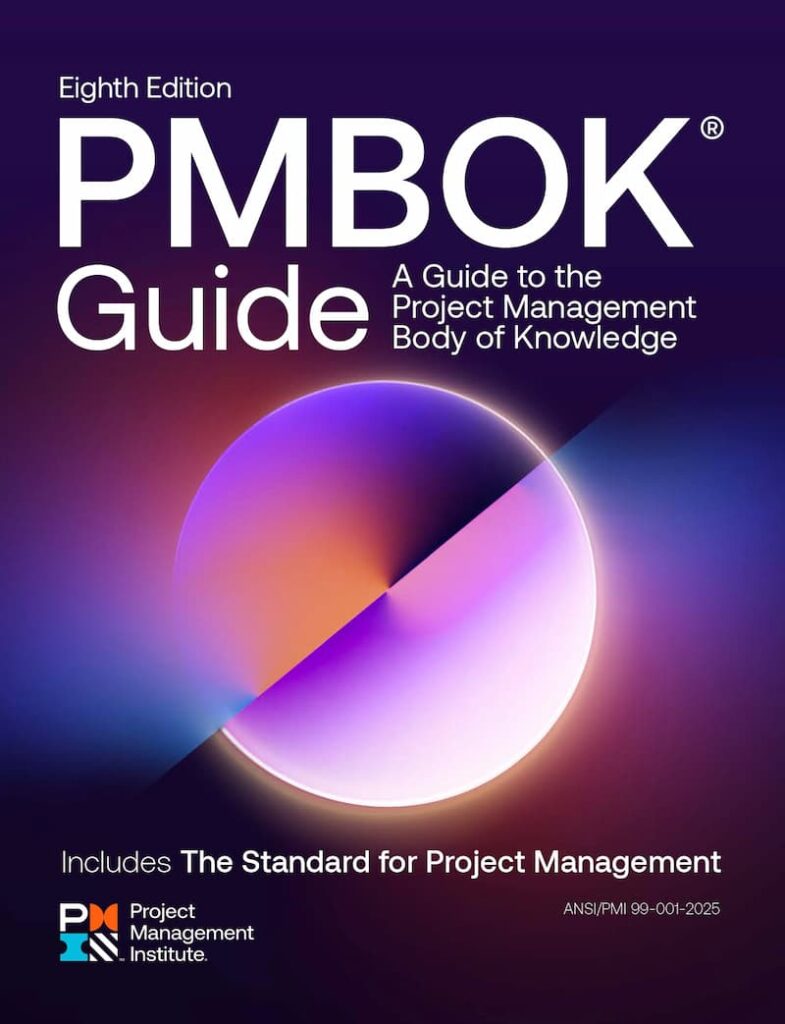
PMBOK 8th Edition: New Exam Foundation (July 2026 and Beyond) was officially released in November 2025 and represents the most comprehensive update since the guide’s inception. As detailed in our PMBOK 8th Edition preview, this version consolidates The Standard for Project Management and the PMBOK Guide into a single integrated publication. It streamlines the principles from 12 to 6 core principles, introduces 7 performance domains (replacing the previous 8), establishes 5 Focus Areas that replace traditional Process Groups, and includes 40 evolved processes (down from 49).
Critically for 2026 exam takers, PMBOK 8 expands coverage of contemporary topics including artificial intelligence applications in project management, sustainability integration, modern PMO evolution, and updated procurement practices. The July 2026 exam will reflect these changes with rebalanced domain weightings: Business Environment dramatically increases from 8% to 26%, while People decreases to 33% and Process to 41%. This shift emphasizes strategic business acumen and value delivery over pure process execution.
Essential Companion: Agile Practice Guide
Approximately 50-60% of PMP exam questions involve agile, adaptive, or hybrid project approaches, making the Agile Practice Guide an indispensable companion to the PMBOK Guide. Published jointly by PMI and the Agile Alliance, this guide bridges traditional project management with agile methodologies.
What the Agile Practice Guide Covers includes core agile principles and mindset, common agile approaches (Scrum, Kanban, XP, Lean), implementing agile in organizations, creating an agile environment, delivering in agile projects, and considerations for tailoring. The guide doesn’t promote a single “correct” agile methodology; instead, it helps you understand when and how to apply agile principles appropriately across different project contexts. This aligns perfectly with the exam’s emphasis on situational decision-making rather than one-size-fits-all solutions.
How to Use This Resource Effectively involves understanding agile not as a completely separate methodology from traditional project management, but as a complementary approach within your project management toolkit. The exam frequently tests your ability to determine when predictive, agile, or hybrid approaches best suit specific situations, assess trade-offs between different approaches, and adapt your leadership style to different team structures and project environments. Don’t treat agile as an isolated topic—integrate it throughout your study of all three exam domains, as agile concepts appear in questions about people management, process selection, and business environment just as frequently as in explicitly “agile” scenarios.
For aspiring project managers wondering how agile compares to traditional approaches, reviewing the fundamental differences outlined in Agile vs Waterfall methodologies provides essential context for exam scenarios requiring methodology selection.
Practical Application: Process Groups Practice Guide
The Process Groups: A Practice Guide, published by PMI in 2022, fills a critical gap for candidates who learned project management through the traditional Knowledge Areas and Process Groups framework. While PMBOK 7 moved away from explicitly organizing content by process groups, many practitioners and exam scenarios still reference these fundamental project phases.
What This Guide Provides includes comprehensive coverage of the five process groups (Initiating, Planning, Executing, Monitoring and Controlling, Closing), reorganization of the 49 project management processes by process group instead of knowledge area, practical guidance on how processes flow through project lifecycles, and clear explanations of inputs, outputs, and relationships between processes. This guide essentially translates PMBOK 7’s principles back into the process-oriented language many project managers naturally use in practice.
Why This Matters for Exam Preparation becomes evident when you encounter exam questions presenting project scenarios at specific lifecycle stages. Understanding which processes typically occur during each phase, how processes in one group feed into others, and what deliverables should exist at transition points helps you quickly identify what should happen next in scenario questions. The guide bridges the gap between PMBOK 7’s conceptual framework and the practical “what do I do when” questions you’ll face on exam day.
Additional Official PMI Publications Worth Considering
Beyond the core three resources (PMBOK Guide, Agile Practice Guide, Process Groups Practice Guide), PMI’s reference list includes several other publications that exam question writers consult. You don’t need to read all of these, but understanding what they offer helps you fill knowledge gaps in specific areas.
The Standard for Project Management (now integrated into PMBOK 8th Edition for 2026 exam takers, but still separate for current exam) establishes the foundational framework for the project management profession. It defines what constitutes a project, describes the value delivery system, and outlines principles that underpin effective project work. If you’re using PMBOK 7th Edition, you may find value in this companion standard for understanding the “why” behind project management approaches.
PMI Lexicon of Project Management Terms provides standardized definitions for project management terminology. While you don’t need to memorize this like a dictionary, it’s valuable for clarifying terminology when multiple study resources use terms differently or when exam questions use specific PMI terminology that differs from common industry usage.
PMI Certification Handbook is mandatory reading that many candidates overlook. This handbook explains exam policies, the application process, PMP certification eligibility requirements, and what to expect on exam day. Reading it prevents application mistakes and ensures you’re prepared for exam logistics, including understanding PMP exam retake policies should you need them.
Top 10 Third-Party References PMI Exam Developers Cite
PMI publicly lists the top 10 non-PMI publications that exam question writers most frequently reference when developing questions. While these aren’t required reading, they represent recognized industry standards and best practices:
Essential Scrum: A Practical Guide to the Most Popular Agile Process by Kenneth S. Rubin (Addison-Wesley) provides comprehensive coverage of Scrum framework and practices. Project Management: The Managerial Processby Erik Larson (McGraw-Hill) offers academic perspective on project management processes. The Project Management Tool Kit: 100 Tips and Techniques for Getting the Job Done Right by Tom Kendrick (AMACOM) provides practical tools and templates. Project Management: A Systems Approach to Planning, Scheduling, and Controlling by Harold Kerzner (Wiley) delivers deep technical coverage of project management systems. Effective Project Management: Traditional, Agile, Extreme, Hybrid by Robert K. Wysocki (Wiley) explores different project approaches and when to use them.
The remaining five references cover specialized topics like technology project management, risk management, and leadership aspects of project work. Most candidates find that thoroughly studying the core PMI publications provides sufficient preparation, consulting these third-party references only for specific areas requiring deeper understanding or alternative explanations of challenging concepts.
Master the Official PMP Reference Materials with Expert Guidance
Understanding what to study is only half the battle—knowing how to effectively learn from these dense, technical publications makes the difference between passing and failing. The PMBOK Guide alone can be overwhelming for first-time readers, and integrating multiple reference sources into cohesive understanding requires strategic approach and expert guidance.
I’ve designed comprehensive PMP preparation resources that don’t just tell you what’s in the reference materials—they teach you how to apply that knowledge to pass exam scenarios. Watch detailed walkthroughs of key concepts from the official PMI publications on my YouTube channel PMPwithRay, where I break down complex PMBOK principles, agile practices, and process relationships into clear, practical explanations that make sense for real-world application and exam success.
For structured preparation that systematically covers all reference materials while building the critical thinking skills you need for scenario-based exam questions, enroll in my comprehensive PMP certification training courses on Udemy. These courses fulfill your required 35 contact hours for exam eligibility while teaching you not just what the reference materials say, but how to think like PMI expects you to think. Whether you’re preparing for the current exam or planning for the July 2026 update, having guidance that aligns your study efforts with official references maximizes your preparation efficiency and exam confidence.
Remember that successfully passing the PMP exam requires more than accumulating study materials—it demands strategic focus on the right resources, deep understanding of core principles over surface memorization, and the ability to apply knowledge in varied scenarios. By centering your preparation on PMI’s official reference list and supplementing with expert-guided training, you position yourself for first-attempt success and a foundation of knowledge that serves your entire project management career.