

You’ve landed your first project management role, and suddenly you’re hearing about “the PMO” in every meeting. Or maybe you’re exploring career paths and wondering whether to aim for a Project Manager position or a PMO role. Here’s the problem: most aspiring project managers don’t understand the fundamental difference between these two critical functions, and this confusion can derail your career trajectory before it even begins. Are you managing projects, or are you governing how projects are managed? By the end of this guide, you’ll have a crystal-clear understanding of PMO vs Project Manager roles, know which path aligns with your career goals, understand the salary implications of each choice, and be able to speak confidently about both functions in interviews and professional settings.
What Exactly Are PMO and Project Manager? Breaking Down the Basics
Let’s start with the fundamentals that every aspiring project manager needs to understand.
A Project Manager is someone who leads and executes individual projects from start to finish. This role involves planning, executing, and closing projects, ensuring they are completed on time, within scope, and on budget. Think of a Project Manager as the person in the trenches—they coordinate teams, manage day-to-day tasks, communicate with stakeholders, handle risks, and solve problems as they arise. They’re right there in the thick of it with boots on the ground and sleeves rolled up.
A PMO (Project Management Office), on the other hand, is something entirely different. The PMO is a centralized organizational unit or department that oversees project management practices across the entire organization or a specific portfolio of projects. A PMO sets standards, processes, tools, and governance frameworks to improve project efficiency, ensure alignment with business goals, and provide strategic oversight.
Here’s a simple way to understand the distinction: The PMO oversees project management at the organizational level, while the project manager focuses on the execution of individual projects. If Project Managers are the conductors of individual orchestras, the PMO is the music director overseeing all the orchestras in the symphony hall, ensuring they all follow the same musical standards and practices. If you’re interested in understanding different project management methodologies that both PMO and Project Managers work with, you might find this guide helpful.
Key Differences: Scope, Responsibilities, and Impact
Understanding the specific differences between PMO vs Project Manager roles is crucial for making informed career decisions.
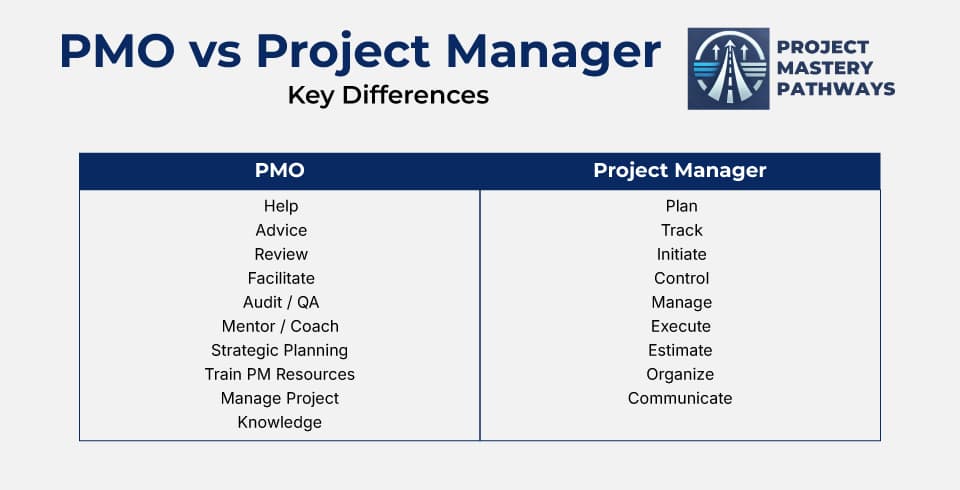
Scope and Focus: The PMO is organizational-level in nature, ensuring every project is directed in accordance with the company’s strategic objectives, while a Project Manager manages a specific project with work scope confined to that project. The PMO takes a strategic, long-term view across multiple projects, while Project Managers focus tactically on their assigned deliverables.
Responsibilities: The PMO develops and implements standard project management practices, guidelines and templates for use across the organisation, provides support and resources to project teams, and facilitates project prioritisation and selection based on strategic goals. In contrast, project managers are directly responsible for project success, leading project execution and handling day-to-day operations of assigned projects throughout the project’s life cycle.
Strategic vs. Operational Decision-Making: The PMO has a strategic role in decision-making, defining project selection criteria, approving methodologies, and setting priorities based on business objectives, while a Project Manager makes tactical decisions regarding an individual project, such as modifying timelines and allocating resources.
Support vs. Delivery: PMs deliver the work, while PMO Managers deliver the conditions for work to succeed. This is perhaps the most elegant way to understand the distinction—Project Managers are accountable for delivering specific project outcomes, while the PMO is accountable for creating the environment where all projects can succeed.
For those exploring project management career paths and wondering which certifications support each role, this comparison might be valuable.
Salary Expectations: PMO vs Project Manager in 2025
Now let’s talk about what really matters—compensation and career growth potential.
PMO Manager Salaries: The average salary for a PMO manager in the U.S. is around $146,930 per year, though this varies significantly based on factors like experience, industry, and location. As of August 2025, the average annual salary for a PMO Manager in the United States ranges from $126,130 (25th percentile) to $155,040 (75th percentile), with a median annual salary of $138,910. In certain industries such as IT, Defense, and Pharma, PMO manager salaries are higher than average, with finance industry PMO managers earning up to $229,000.
Project Manager Salaries: The average salary for a project manager is approximately $143,350 per year. The average salary for a PMO Project Manager is $121,168 per year, with the typical pay range between $94,555 (25th percentile) and $156,910 (75th percentile) annually.
The salary data reveals an interesting trend: while PMO Manager roles generally command slightly higher compensation on average, both career paths offer substantial earning potential. Your ultimate earning capacity depends more on your experience level, industry, and the strategic value you bring than on which specific role you choose. If you’re curious about how project management salaries compare across different regions, check out this comprehensive salary guide.
Choosing Your Path: Which Role Is Right for Your Career Goals?
So which should you pursue—Project Manager or PMO roles?
Choose Project Manager if you:
- Love being hands-on and directly delivering results
- Enjoy solving operational problems in real-time
- Thrive on variety and managing different types of projects
- Want to lead teams and coordinate cross-functional stakeholders
- Prefer tactical execution over strategic governance
Choose PMO if you:
- Enjoy creating systems, processes, and frameworks
- Think strategically about how to improve organizational effectiveness
- Love data analysis and portfolio-level decision-making
- Want to influence how an entire organization manages projects
- Prefer advisory and governance roles over direct project execution
Here’s the good news: you don’t have to choose one path forever. Lots of people in PMO started out in delivery, and plenty of PMs benefit hugely from understanding how PMOs work—it’s all part of the same ecosystem. Many successful PMO leaders spent years as Project Managers first, gaining the operational experience that makes them effective at creating organizational frameworks.
Ready to accelerate your journey in project management?
Whether you’re pursuing a Project Manager or PMO career path, building a strong foundation in project management principles is essential for success. Subscribe to my YouTube channel, PMPwithRay, where I break down complex project management concepts into practical, actionable guidance for aspiring PMs. For comprehensive training that covers both tactical project execution and strategic project governance, explore my project management courses on Udemy, where you’ll gain the skills to excel in either career path and position yourself for long-term success in 2025 and beyond.