
You’re about to start a new project, and suddenly everyone on your team has strong opinions about whether to use “Agile” or “Waterfall.” Your stakeholders are asking which approach you’ll take, but you’re not entirely sure what the real differences are—or more importantly, which methodology will actually help your project succeed. Should you embrace the flexibility of Agile, or stick with the structured predictability of Waterfall? Making the wrong choice could mean missed deadlines, budget overruns, and frustrated team members. By the end of this guide, you’ll understand exactly how these two methodologies differ and which one is right for your specific project scenario.
What Are Agile and Waterfall Methodologies? Understanding the Basics
Before diving into the differences, let’s clarify what each methodology actually means—especially if you’re new to project management.
Waterfall is a sequential, linear approach to project management where each phase must be completed before the next one begins. Think of it like a waterfall flowing downward through distinct stages: requirements gathering, design, implementation, testing, deployment, and maintenance. Once you move from one phase to the next, you typically don’t go back. This methodology has been around since the 1970s and follows a highly structured, plan-driven approach. To understand why this methodology earned its distinctive name, check out this explanation of why waterfall type project management is called ‘waterfall’.
Agile, on the other hand, is an iterative and incremental approach that embraces flexibility and continuous improvement. Instead of completing the entire project in one go, Agile breaks work into small, manageable chunks called “sprints” (typically 1-4 weeks long). After each sprint, you deliver a working piece of the product, gather feedback, and adjust your plans accordingly. Agile emerged in the early 2000s specifically to address the limitations of traditional methodologies in fast-paced, uncertain environments.
In Agile projects, you’ll encounter specific roles that don’t exist in Waterfall, such as Scrum Masters and Product Owners. To better understand how these roles function, explore this comprehensive guide on types of roles in Agile projects.
Agile vs Waterfall: A Side-by-Side Comparison
Understanding the fundamental differences between these methodologies will help you make informed decisions about which approach suits your project needs.
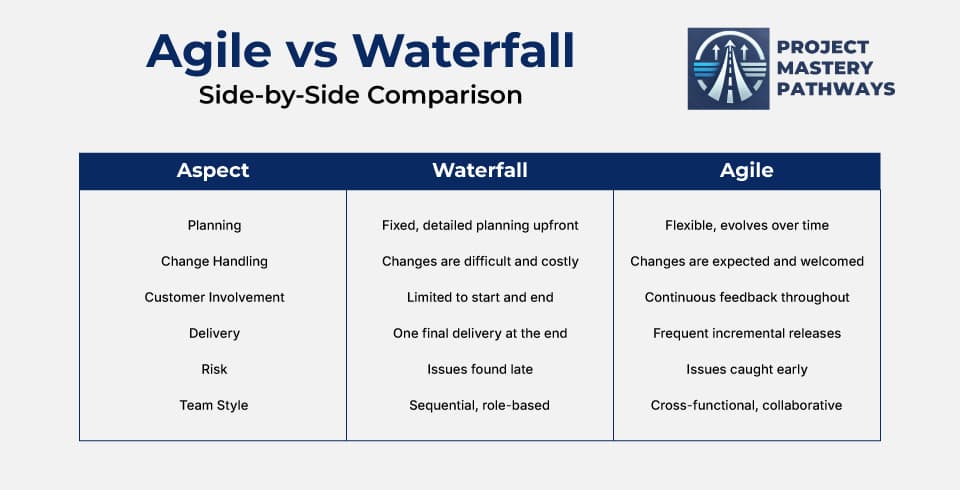
Planning and Flexibility: Waterfall requires comprehensive upfront planning—you need to define all requirements, timelines, and deliverables before starting work. Changes after project initiation are difficult, costly, and often discouraged. Agile, conversely, embraces change as a natural part of the process. You start with a high-level vision and refine details as you progress, allowing you to pivot based on new information or changing market conditions.
Customer Involvement: In Waterfall projects, customers are primarily involved at the beginning (requirements gathering) and end (final delivery). They don’t see the product until it’s complete. Agile maintains continuous customer involvement throughout the project lifecycle, with regular demonstrations and feedback sessions after each sprint, ensuring the final product truly meets evolving customer needs.
Delivery Timeline: Waterfall delivers the complete product at the end of the project—this could be months or even years after initiation. Agile delivers working increments of the product every few weeks, allowing customers to start seeing and using functionality much earlier, even if the complete product isn’t finished.
Risk Management: Waterfall carries a higher risk because you don’t test your assumptions until late in the project. If something is wrong with the initial requirements, you might not discover it until testing phase—when changes are most expensive. Agile mitigates risk through frequent testing and feedback loops, catching issues early when they’re easier and cheaper to fix.
Team Structure: Waterfall typically uses specialized teams where experts work sequentially—designers hand off to developers, who hand off to testers. Agile employs cross-functional teams where designers, developers, and testers work together simultaneously, promoting collaboration and shared ownership.
When to Use Agile vs Waterfall: Choosing the Right Methodology
Neither Agile nor Waterfall is inherently “better”—the right choice depends on your specific project context, constraints, and objectives.
Choose Waterfall when:
- Requirements are well-defined, stable, and unlikely to change
- The project has fixed scope, budget, and timeline constraints
- You’re working in highly regulated industries requiring extensive documentation
- Your stakeholders prefer predictability and detailed upfront planning
- The technology and tools are well-established and proven
Construction projects, manufacturing initiatives, and infrastructure development are classic examples where Waterfall excels. For specific industry applications, read about industries where waterfall type project management works best and explore examples of waterfall type projects.
Choose Agile when:
- Requirements are uncertain or likely to evolve
- You need to deliver value quickly and iteratively
- Customer feedback is crucial to product success
- You’re working on innovative products in competitive markets
- The project involves complex problems requiring experimentation
Software development, mobile app creation, digital marketing campaigns, and product innovation initiatives typically benefit from Agile approaches.
Master Both Methodologies to Maximize Your Career Potential
Understanding the difference between Agile and Waterfall isn’t just about choosing sides—it’s about becoming a versatile project manager who can select and apply the right methodology for each unique situation. Many modern organizations use hybrid approaches, combining elements of both methodologies to create customized solutions that leverage the strengths of each.
Ready to deepen your understanding of both Agile and Waterfall methodologies? Subscribe to PMPwithRay on YouTube for practical tutorials, real-world examples, and expert insights on applying these methodologies effectively. For comprehensive training that covers both traditional and Agile approaches, enroll in my Project Management Basics for Project Managers course on Udemy, where you’ll gain 16 PDUs while mastering the foundational concepts that every successful project manager needs.
The best project managers don’t limit themselves to one methodology—they master both and know exactly when to apply each. Start building that expertise today.